
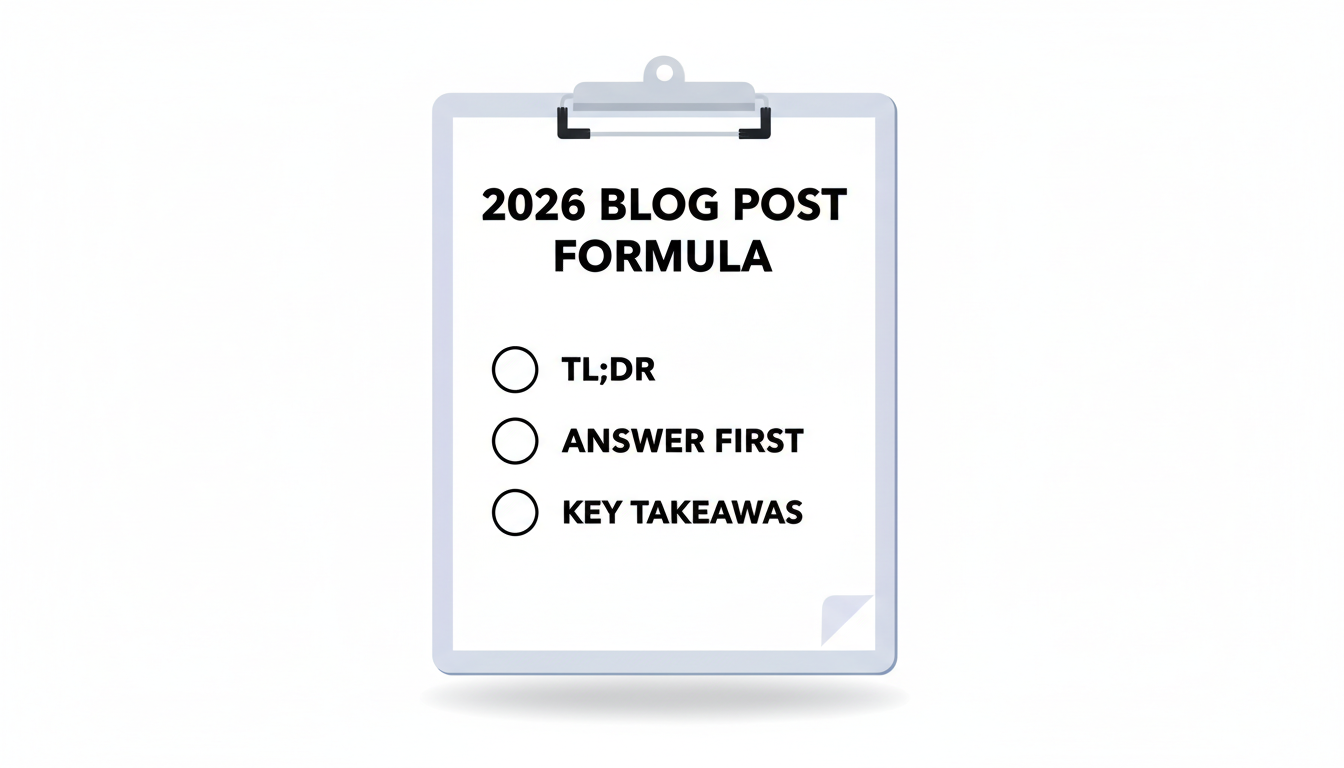
How to Write Blog Posts in 2026 That Get Traffic: The Homer Simpson Method
 Reading Time: 3 minutes
 TL;DR Summary: To get traffic in 2026, start with a short TL;DR, answer the headline question immediately, then end with 3–5 key takeaways. Make it impossible to misunderstand.
If you want your blog posts to rank in Google and show up in AI answers (ChatGPT, Claude, Google AI Overviews, etc.), you don’t need to write “smarter.” You need to write clearer.
That’s the whole joke behind what I call the Homer Simpson Method: we “dumb it down” on purpose. Not by removing value, but by removing friction. We make the content so easy to digest that both humans and machines can’t miss the point.
The Big Idea: Write Like It’s Being Skimmed
In 2026, your post gets scanned by busy humans, Google, and AI systems that pull snippets, summaries, and “answers.” So your content needs to work even if someone reads only the first 20 seconds, only the first section, or only the bottom.
This is what “AI Markdown” really means in plain English: structure your writing so it’s easy to extract.
And it boils down to three rules.
Rule #1: Put a TL;DR at the Very Top
Right after the title, add one to two sentences that stand alone. If Google or an AI only grabs that, the reader should still understand what the post is about and what to do.
Use this pattern:
TL;DR: [What to do] + [why it works] + [what they’ll get].
- Why it works for AI: it gives answer engines something clean to pull.
- Why it works for humans: it instantly confirms they’re in the right place.
Rule #2: Answer the Question Immediately
I’ve been preaching this for a long time now because it works. I’ve tested it. I have proof.
Most blog posts still do the thing where they “set the stage” for a few hundred words before answering the title. That’s a bounce-rate generator.
Your first real section should directly answer the post title.
Example: If your headline is “How Much Does SEO Typically Cost?” then the first section should say what SEO typically costs, and what the main variables are. The details can come after.
A simple formula that keeps people reading
- Direct answer (1–3 sentences)
- Quick context (why it varies)
- Breakdown (tiers, scenarios, examples)
- What to do next (how to decide, how to avoid mistakes)
Think of it like this: people don’t want a story first. They want relief first. Once they feel like you solved the main problem, they’ll stick around for the nuance.
Rule #3: End With Key Takeaways (So Skimmers Still Win)
A lot of readers scroll straight to the bottom to see if you’re worth their time. Reward that behavior.
End your post with 3–5 bullet points that summarize what matters. Not fluffy bullets. Real “okay, got it” bullets.
What This Looks Like in a Real Blog Post Structure:
Here’s a clean outline you can copy for almost anything:
- TL;DR (1–2 sentences)
- Direct answer to the headline (1–3 sentences)
- Simple explanation (who this applies to + what changes the answer)
- Examples (make it concrete)
- Mistakes to avoid (this keeps them reading)
- What to do next (clear next step)
- Key takeaways (3–5 bullets)
Why the Homer Simpson Method Works
Because clarity is a ranking factor now, whether Google calls it that or not. And this even works for serious topics.
- Readers stay longer because they’re not annoyed.
- They scroll because it feels easy.
- They trust you more because you answered them fast.
- AI systems can extract the “best answer” without guessing.
You’re not making your content “dumber.” You’re making it more usable.
Key Takeaways
- Add a TL;DR at the top so the point lands instantly.
- Answer the headline question immediately in the first section.
- Use scannable structure (short paragraphs, headings, lists).
- End with 3–5 takeaways so even skimmers leave with clarity.
- Write like you’re being skimmed by a busy human and a machine, because you are.
📄 Download a PDF of This Article


