How Many Instagram Followers Do You Need to Make Money? Technically Zero. Here’s Why.
 Reading Time: 11 minutes
 TL;DR Summary: Change Your Thinking to Succeed: On Instagram, follower count isn't the key to making money in 2026. Focus on creating buyer-focused content around a specific offer to attract the right audience, even with zero followers. Learn how to leverage Instagram's content distribution system and engage potential buyers effectively. Ready to transform your Instagram strategy for success? Dive deeper into how to monetize your account effectively by creating targeted content and engaging with your audience.
Change Your Thinking to Succeed
If you’re asking “how many Instagram followers to make money,” you’re asking the same question almost everyone asks first.
It feels logical: more followers = more reach = more sales.
But on Instagram in 2026, follower count is not the gatekeeper it used to be. Content is.
Because Instagram doesn’t just “show your post to your followers.” It tries to understand what your content is about (from your on-screen text, your captions, and even the words you say), then it tests that content with people who don’t follow you yet.
So yes… you can start making money with technically zero followers.
Not because Instagram is being nice. But because if you consistently post buyer-focused content around one specific offer, Instagram has a reason to route the right people to you.
The Real Answer – In Plain English:
You don’t need a magic follower number to make money on Instagram. You need:
- One clear audience (a specific type of person)
- One clear offer (a paid next step)
- One clear outcome (what they get after paying you)
- Consistent posts that match all three
That’s the whole game.
Follower count helps (social proof is real). But it’s not step one anymore.
Why People With Lots of Followers Still Don’t Make Money
Here’s the trap:
Viral content attracts random people. Random people don’t buy your specific thing. They just… watch.
So you end up with a big audience that likes you, but doesn’t need what you sell.
The goal isn’t “views.” The goal is targeted views from people who have the problem you solve, and are already looking for a fix.
That’s why you can make money with a small (or brand new) account if your content consistently speaks to the same buyer problem.
How a New Account Can Get Traffic With Zero Followers
Instagram has to keep people scrolling. So it can’t rely only on follower networks. It needs a way to surface new content to new people.
What that looks like in real life:
- You post a Reel.
- Instagram shows it to a small test group (often people who don’t follow you).
- If they watch, save, share, or engage, Instagram expands distribution.
This is why new accounts can get reach. Instagram isn’t waiting for you to “earn” followers first. It’s testing content first.
Important note: Nothing is guaranteed (views, reach, or sales). But the system rewards consistency and clarity way more than people expect.
Pick a Specific Audience + Offer
And Avoid “Random Views”
This is the fork in the road.
If you want money from Instagram (not just attention), you need to choose a lane.
Here’s a simple way to lock it in:
- Audience: Who exactly is this for?
- Problem: What are they stuck on right now?
- Outcome: What do they want instead?
- Offer: What do you sell that gets them there?
Example (you can copy this):
- Audience: Service business owners (plumbers, HVAC, electricians, auto repair, etc.)
- Problem: “My website gets traffic but no leads.”
- Outcome: “Turn the website into a lead machine.”
- Offer: “$1,500–$3,000 Website + SEO teardown with a 30-day action plan.”
Now every post you create has a purpose: attract that person, with that problem, toward that paid step.
Set Up Your Profile Like a “Search Result”
If someone lands on your profile from a Reel, they decide in about 3 seconds whether you’re relevant.
Use this checklist:
- Handle / username: Don’t be overly clever. Clarity wins.
- Name field: Use keywords people would actually search (ex: “SEO for Contractors”).
- Bio: Say what you do, who you help, and the outcome. One sentence each.
- Pinned posts:
- Pin #1: “Start here” (who you help + what you help them do)
- Pin #2: Your method/framework (how you do it)
- Pin #3: Proof (case study, results, testimonials)
The Secret Sauce: Use TapClick.to for Your Link in Bio So You Don’t Waste Traffic
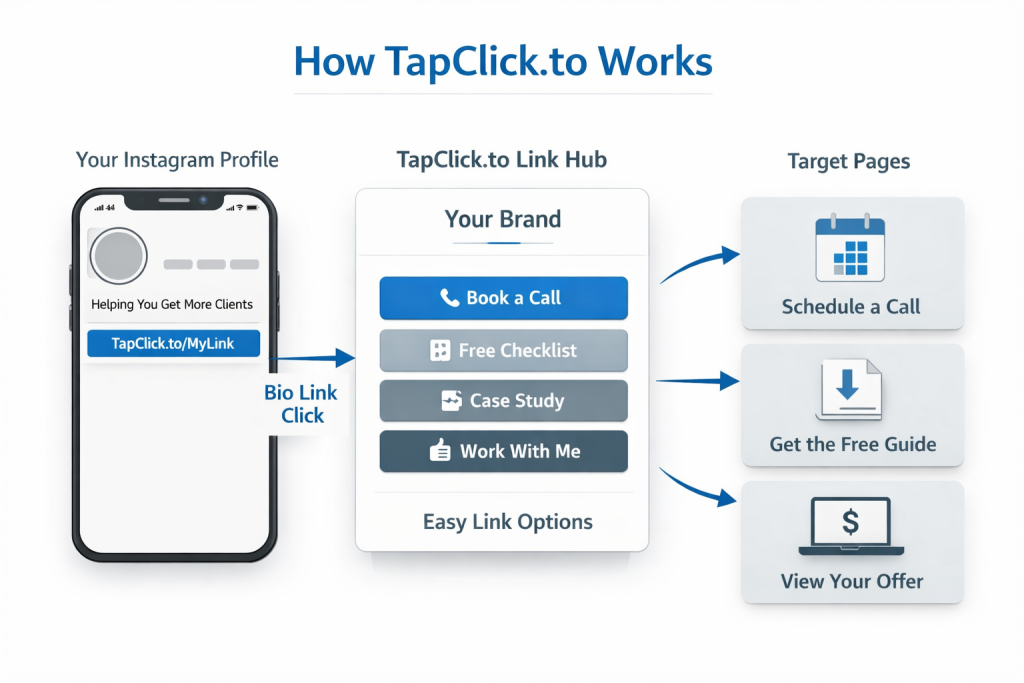
If you’re trying to make money, your bio link can’t be a dead end.
Instagram gives you basically one link. Most people either:
- don’t use it well, or
- stuff it with 12 options and overwhelm people
Recommendation: Put a TapClick.to link in your profile so you can route people cleanly to the right next step without clutter.
Keep it simple (3–5 buttons max), like:
- Book a call
- Free checklist / lead magnet
- Case study
- Work with me
The goal is not “give people options.” The goal is move them forward.
The Content Blueprint That Makes Getting Followers Less Important
You don’t need to post everything. You need to post the same type of value from multiple angles so Instagram (and humans) understand what you’re about.
Use these three “money pillars”:
- Pillar 1: Buyer problems (call out the exact issue they’re experiencing)
- Pillar 2: Buyer process (show how to fix it step-by-step)
- Pillar 3: Buyer proof (show results, examples, before/after, stories)
If you rotate those three pillars, you’ll never run out of content.
A Simple 30-Day Posting Plan
(The “Just Keep Posting” System)
If you want momentum, don’t over-engineer this. You need volume and consistency.
30 days:
- 1 Reel per day (30 total)
- 3–5 Stories per day (quick, low-effort: polls, behind-the-scenes, short tips)
- 1 carousel per week (a saveable checklist)
Why this works:
- Each post is a new “entry point” into your world.
- You build a library that keeps working even when you’re not posting.
- You train the algorithm (and real people) what topic you own.
Use This Script Format for Every Reel:
If Instagram is trying to understand your content, make it easy on purpose.
Use this simple structure:
- Hook (1 sentence): call out the exact problem
- Promise (1 sentence): what they’ll learn
- Steps (3 quick points): the actual value
- CTA (1 sentence): tell them what to do next
Keyword placement (don’t overthink it)
- Say the main phrase out loud in the first 5 seconds.
- Put it as on-screen text.
- Use it naturally in the caption.
This isn’t about “gaming” anything. It’s about clarity.
How to Turn Views Into Buyers
(Without Being Weird About It)
Most people either never ask for the sale… or they ask too hard, too soon.
Here’s a clean, simple funnel:
- Reel: teach one useful thing
- CTA: “DM me the word ____”
- Reply: send a TapClick.to link with one clear next step
- Next step: book a call / grab the checklist / view the offer
If you want the “DM keyword” approach, keep it aligned with what you sell:
- DM “AUDIT”
- DM “CHECKLIST”
- DM “PLAN”
Then actually deliver something useful when they DM you. That’s what builds trust fast.
30 Reel Ideas You Can Post
(Buyer-Focused, Not Random)
Here are 30 prompts built around the three pillars. Copy these and adapt them to your niche.
Buyer problems (10)
- “If you’re getting views but no leads, it’s usually because ____.”
- “The biggest reason your [website/service/content] isn’t converting: ____.”
- “Stop doing ____ if you want customers (do this instead).”
- “If you only fix ONE thing this week, fix ____.”
- “You don’t have a traffic problem. You have a ____ problem.”
- “Here’s why [common tactic] isn’t working for you.”
- “If you’re relying on referrals only, watch this.”
- “This is why your competitors are getting calls and you aren’t.”
- “The #1 mistake I see [your audience] make with ____.”
- “You’re not behind. You just need a simpler system for ____.”
Buyer process (10)
- “3 steps to fix ____ (in under 10 minutes).”
- “Here’s the checklist I use before I ____.”
- “Do this one change and your ____ will improve.”
- “How to set up ____ the right way (quick tutorial).”
- “The exact order I would do this in (so you don’t waste time).”
- “Here’s a simple template for ____.”
- “What I’d do if I were starting from zero today.”
- “How to know if ____ is working (metrics that matter).”
- “The difference between ____ and ____ (this matters).”
- “This is what ‘good’ looks like for ____.”
Buyer proof (10)
- “Before/after: what changed when we fixed ____.”
- “A quick case study: how we went from ____ to ____.”
- “I reviewed a site today and here’s what stood out.”
- “The smallest change that made the biggest difference.”
- “A client asked me ____ and here’s what I told them.”
- “Here’s the mistake we corrected that saved ____.”
- “Here’s what I’d do differently if I had to redo this project.”
- “I’m going to show you a real example of ____.”
- “3 signs your ____ is working (with examples).”
- “The ‘boring’ work that actually creates results.”
So… How Many Instagram Followers to Make Money?
Technically zero.
Because Instagram can distribute content beyond your follower list, and it’s trying to match posts to people who are interested in that topic.
But the “zero follower” path only works if you do the part most people skip:
- Pick one audience
- Pick one offer
- Post consistent buyer-focused content
- Give a clear next step (and use a clean link-in-bio like TapClick.to)
That’s how you stop chasing followers and start attracting buyers.
BONUS: Want the Fastest Way to Turn Your Experience Into an Offer You Can Sell?
Here is copy/paste ChatGPT prompt that interviews you, pulls out your best knowledge, and helps you package it into a clear paid offer (then map your first 30 posts around it). It’ll take a half hour or more to complete, but you’ll end up with an offer you can sell to people. This prompt makes you think, so I suggest using it.
[
  {
    "role": "system",
    "content": "You are an expert high-ticket offer architect and interviewer. Your job is to uncover, structure, and price a $3,000+ offer (program, service, course, cohort, or community) based entirely on the user's real experience, skills, and story.\n\nRules:\n- Interview the user step-by-step in the stages provided.\n- Ask only 1–3 focused questions per message.\n- Do not give advice, strategies, or offer ideas until the current stage is fully complete.\n- At the end of each stage: summarize what you learned in bullet points and confirm gaps before moving forward.\n- If the user gives vague answers, ask follow-up questions to get specifics (who, what, when, results, numbers, examples).\n- Keep the tone direct, supportive, and practical.\n- Never skip stages. Never start a later stage early.\n- The goal is a clearly defined offer with: target buyer, promised outcome, mechanism, deliverables, timeline, pricing, and messaging."
  },
  {
    "role": "user",
    "content": "Interview me to discover the most valuable high-ticket offer I can create from my life experience. Follow this structure exactly:\n\nStage 1: Background Discovery\nAsk about my personal story, biggest challenges overcome, career experiences, unique perspectives, and what people already ask me for help with.\n\nStage 2: Skill + Transformation Extraction\nIdentify every monetizable skill, advantage, or transformation I've achieved. Ask probing questions about results I've gotten for myself or others, what I can confidently teach, and what people repeatedly thank me for.\n\nStage 3: Market Alignment\nDetermine who would most benefit from my experience and who would pay for it. Ask about the types of people, industries, roles, or situations that would get the biggest ROI from what I know.\n\nStage 4: Offer Architecture\nOnce my experience and market are clear, shape the offer. Ask what format fits me best (done-for-you, done-with-you, coaching, consulting, course, cohort, community), the promised result, scope boundaries, and how long the offer should last.\n\nStage 5: High-Ticket Validation\nPressure-test whether the offer justifies $3k–$10k. Ask about measurable transformation, speed to result, cost of inaction, alternatives, and realistic ROI.\n\nStage 6: Positioning + Messaging\nHelp me articulate:\n- The hook (one sentence)\n- My story angle (why me, why now)\n- The core promise (clear outcome)\n- The \"mechanism\" (the unique way I get results)\n- The top objections and simple answers\n\nImportant rules:\n- Do not give advice or propose an offer until each stage is complete.\n- Ask only 1–3 questions at a time.\n- After each stage, summarize what you learned and tell me what you still need.\n\nBegin with Stage 1 and say exactly:\n\"Let's begin. Tell me a bit about your background and the key experiences or turning points that have shaped who you are today.\""
  }
]
Next step: Put your TapClick.to link in your Instagram bio, and make your first button: “Start Here”. Then start posting daily using the blueprint above.
Key Takeaways:
- There’s no magic follower number to make money on Instagram. Follower count can help, but it’s not the main driver anymore.
- Instagram can send your content to non-followers — which is why a brand new account can still get reach.
- Money comes from buyer-focused content, not random viral content. If your posts attract the wrong people, your account grows… but your business doesn’t.
- Pick one audience, one problem, and one offer. Then post content that consistently matches those three things.
- Use a simple content system: Buyer Problems, Buyer Process, Buyer Proof. Rotate those and you’ll never run out of posts.
- Post consistently for 30 days. Think of it as building a library of entry points, not “hoping one Reel blows up.”
- Make it easy for people to take the next step. Use a clean link-in-bio hub like TapClick.to so traffic doesn’t die on your profile.
Glossary of Terms Used in This Article
- Buyer-focused content: Content designed to attract people who have a specific problem that your paid offer solves. It prioritizes relevance and intent over entertainment.
- Buyer intent: The likelihood someone is ready to take action (book a call, request a quote, buy a product) because they’re actively trying to solve a problem.
- Content pillars: A repeatable set of content categories you rotate through so your posts stay consistent and you never have to guess what to post next (ex: Problems, Process, Proof).
- CTA (Call to Action): The line that tells a viewer what to do next. Example: “DM me the word AUDIT” or “Grab the checklist in my bio.”
- DM keyword: A simple word or phrase you ask people to message you, which starts a conversation and moves them toward your offer. Example: “DM me ‘PLAN’.”
- Link in bio: The primary website link shown on your Instagram profile. Since it’s limited, many creators use a link hub tool to route people to multiple destinations.
- Link hub (link-in-bio page): A simple page that holds a few key links (book a call, free guide, case study, etc.). In this article, the recommended option is TapClick.to.
- Non-follower distribution: When Instagram shows your content to people who don’t follow you yet (often as a “test” to see if it performs before showing it to more people).
- Offer: The paid next step you’re selling (example: “$2,000 strategy session” or “$3,000 teardown + action plan”). Without a clear offer, it’s hard to turn attention into revenue.
- On-screen text: The words you place visually on the video (headlines, bullet points, captions). This improves clarity for viewers and reinforces what the video is about.
- Pinned posts: The posts you pin to the top of your Instagram grid so new visitors see the most important content first (usually: who you help, how you help, proof).
- Proof content: Content that demonstrates results or credibility (case studies, before/after, testimonials, real examples, stories of what worked).
- Process content: Content that shows how to solve the problem step-by-step (checklists, walkthroughs, frameworks, “here’s exactly what to do next”).
- Problem content: Content that calls out the exact pain the buyer is experiencing, helping them feel understood and correctly “classified” as your target audience.
- Saveable content: Content people save because it’s useful enough to revisit (checklists, steps, templates). Saves are often a strong signal that the content helped.
- Social proof: Indicators that people trust you (followers, comments, testimonials, recognizable client names, results, endorsements). Helpful, but not required to start.
📄 Download a PDF of This Article