Keyword Research in the Age of AI: How to Show Up in Search Results and LLM Answers
 Reading Time: 6 minutes
 TL;DR Summary: Keyword research isn’t just about “what will rank on Google” anymore. Large language models (LLMs) are pulling from places like YouTube and Reddit, and they reward content that’s clear, structured, and evidence-backed. Your job: map topics to entities and questions, publish machine-readable answers (schema + Q&A format), and expand coverage to the platforms AI actually cites. Then measure success beyond blue links. Get a downloadable PDF checklist at the end for free - no email required.
What Has Changed and Why It Matters for Keyword Research
The Search Evolution Summit in Romania this year made one thing obvious: the line between traditional search and AI answers is fading. That affects your research process.
- LLMs are citing new sources. YouTube transcripts and Reddit threads increasingly influence AI outputs. That broadens your “SERP.”
- AI is a new “business card.” How you appear in AI answers now shapes perceived authority—sometimes more than a classic ranking.
- Content is still king, if machines can parse it. LLMs need clean, grounded material. Think structured, factual, and easy to quote.
Translation for keyword research: stop thinking only in terms of keywords → positions. Start thinking in terms of entities, questions, and evidence that can be reused across Google, YouTube, Reddit, and AI. It’s about content, but not the content AI can give. Remember, do what AI can’t do. That includes original research, your own experience (huge), or combining things that AI doesn’t have access to.
The Model: Entities → Questions → Evidence (E→Q→E)
Instead of starting with search volume alone, build topics like this:
- Entities: People, brands, products, places, and concepts (e.g., “colored contact lenses,” “trial programs,” “FDA guidance”).
- Questions: Every practical question users ask around those entities (who/what/where/when/why/how, pros/cons, safety, cost, alternatives). Be helpful and use your own experience.
- Evidence: Documents, data, screenshots, citations, policies, and first-hand experience that make your answers quotable.
LLMs (AI/ChatGPT) compress answers. Give them material that’s easy to compress.
Where to Find Today’s Best Keywords and Questions
1. YouTube (transcripts, chapters, comments)
Mine transcripts for recurring phrases and problem language. See what people are asking. Pull video “chapters” as subtopics. If you publish video yourself, add tight titles, chapters, and a clear description. Embed video + transcript on your page.
2. Reddit (pain, objections, real use-cases)
Look for threads with sustained engagement. Extract exact phrases users use to describe their problem (“pain language”). Those become headings (H2/H3) and FAQ entries.
3. PAA, AlsoAsked, and Autosuggest
Use features like People Also Asked (PAA) in Google to shape a Q&A section and decide which “nearby” questions deserve their own page (vs. live as on-page FAQs).
4. Your data: GSC + site search + support inbox
Low-impression queries in GSC (Google Search Console) often expose hidden demand. Site search shows friction. Support emails reveal wording that will resonate.
5. AI answers and gaps
Ask LLMs (Large Language Models) the query and note what’s missing or outdated. If Reddit/YouTube dominate, plan matching assets on those platforms (ethical, non-spam contributions) and link back to your canonical explainer.
Clustering for the AI Era: Formats That Win
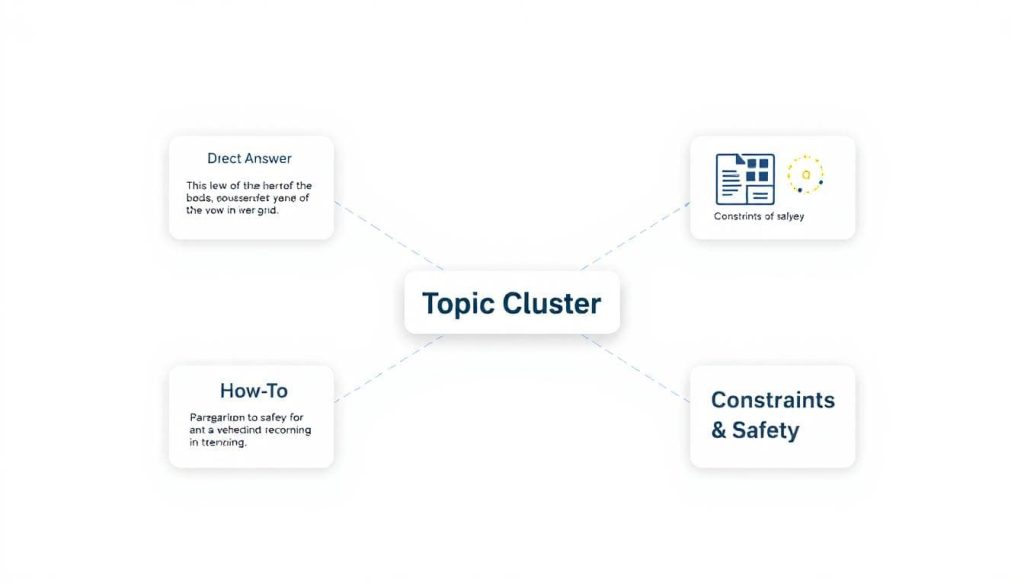
Clusters aren’t just “topical.” They’re format-aware:
- Direct answers: One clear paragraph + a short bulleted proof list.
- How-to / process: Numbered steps, materials list,
HowToschema, optional short video. - Comparisons: Clean tables with specs and eligibility criteria (LLMs love tidy tables).
- Constraints & safety: Legal, medical, warranty boundaries (evidence + dates).
- Glossary/entity stubs: Short pages for core entities you reference often.
On-Page: Make It Machine-Readable (Without Killing Readability)
- Lead with a concise answer. Put your best one-paragraph answer near the top. Then expand. People will be happy to get the answer, then stick around for more.
- Use Q&A blocks. Turn PAA questions into on-page questions with short answers.
- Add schema:
Article,FAQPage,HowTo,VideoObjectwhere relevant. Use accurateOrganization/PersonwithsameAslinks. - Timestamp facts. Where policies change, note “Updated: Month Year.”
- Tables beat walls of text. Especially for comparisons, requirements, and eligibility.
- Multimodal helps. Short video + transcript + stills. YouTube improves your odds of being cited by LLMs.
Prioritize with an “Answerability Score” (simple, practical)
Give each candidate topic a 1–5 score for the following, then sort by total:
| Factor | 1 | 3 | 5 |
|---|---|---|---|
| Business Value | Low fit | Some fit | Strong lead/aff value |
| Search Demand | Tiny | Moderate | Healthy |
| Competitor Softness | Heavy incumbents | Mixed | Thin/dated content |
| Format Match | Hard to structure | OK | Perfect for Q&A/table/video |
| Evidence Available | Little | Some | Strong docs/data/screens |
Start with the 15–20 highest totals. That’s your near-term content plan.
Example Mini-Cluster:
Let’s use “free colored contacts trials” as a keyword phrase as an example to ground the method in something concrete.
Intent Buckets
- Direct answer: “How to get free colored contacts trials”
- Eligibility & safety: “Who qualifies / what’s required? Are they safe? Do I need a prescription?”
- Brand/program specifics: “[Brand] trial policies, how they work, what’s included, shipping times”
- Compare & alternatives: “Trials vs coupons vs rebate programs vs sample packs”
- Care & use: “How to try them safely, hygiene steps, what to watch for”
Page Set
- Hub: “How to Get Free Colored Contacts Trials (Safely)” with a plain-English checklist and links to brand pages.
- Brand Pages: One page per major brand’s current policy (table with requirements, regions, cost, expiration).
- FAQ Page: “Trials vs coupons vs promo kits: what’s the difference?”
- Care Guide: Short how-to with steps and a 60–90s video (transcript included).
Include dates, screenshots, and official links so LLMs can anchor to something current and quotable. Bring in your own experience, expertise, and information you have to make this content unique (important).
Distribution Beyond Your Site (because AI reads the room)
- YouTube: 60–120s explainer with chapters. Link back to your canonical guide.
- Reddit: Answer high-signal threads with non-promotional specifics. Summarize policy gotchas, then link for the detailed table.
- Quotes/PR: Offer short, citable statements to journalists/creators. LLMs love compact quotes.
How to Measure Success (Beyond Rank)
- Google: Impressions/clicks for question queries, FAQ rich results, Discover visibility.
- YouTube: Impressions, CTR, retention, and “suggested” traffic (your video as a cited source).
- Reddit: Karma and saves on your informative posts.
- Brand queries: Rise in “[brand/topic] + your name” and navigational searches.
- Revenue proxies: Form fills, email signups, affiliate clicks (by page).
If you’re using the clustering feature in the Premium Report on RankCheck Pro, track the cluster’s blended visibility: keyword positions + SERP features + a simple “answerability” rating you update monthly.
Process You Can Repeat Every Month
- Pull new question ideas from GSC, YouTube transcripts, Reddit threads.
- Score with the Answerability Score. Pick 4–6 to ship.
- Draft: lead with the answer, add proof (screens, tables, citations).
- Add schema (Article + FAQPage/HowTo), embed short video.
- Post a helpful summary to Reddit (where appropriate) and a matching short on YouTube.
- Review metrics in 30 days. Update dates and proof as needed.
Internal Links to Add (Suggestions)
- Link to your Buyer-Intent Keywords resource (anchor: “buyer-intent keywords list”).
- Link to Using Keywords to Establish Experience, Expertise, Authority and Trust (anchor: “build trust with keyword choices”).
- Mention RankCheck Pro (anchor: “cluster tracking and SERP feature checks”).
Get the AI-Ready Keyword Research Checklist (Free PDF)
One page. Free download – no email required.
Print-friendly. Covers inputs, on-page structure, schema, and LLM distribution.
- Q&A formatting that AI can quote
- “Answerability Score” quick prioritization
- Distribution plan for YouTube + forums
Quick FAQs About Keyword Research in the AI Era
How is AI changing keyword research?
You’re optimizing for both Google and the places AI pulls from (YouTube, Reddit). That means more Q&A formatting, more evidence, and more structured data.
Do I still chase volume?
Yes—but weigh volume against answerability and business value. Low-volume, high-intent questions often win in both search and AI.
What schema matters most?
Start with Article, FAQPage, HowTo, and VideoObject when you have video. Keep it truthful and consistent.
How do I get cited by AI?
Publish clean answers, show your work (tables, dates, screenshots), and place helpful summaries on platforms LLMs read. Be the source you’d quote.
📄 Download a PDF of This Article