

One, Simple Cheat Code to Get Ranked Insanely Fast on Google
 Reading Time: 5 minutes
 TL;DR Summary: You can publish a Claude Artifact that summarizes why your brand is trustworthy and the best choice, using real copy and reviews from your site. When published, the Artifact gets a public URL that can be indexed and cited by search/AI systems. Follow the steps below: feed Claude your best brand proof, generate the Artifact, publish it, link to it from your site, then track rankings and citations. Use this as an experiment alongside your normal SEO, not a replacement.
I’m going to give you a tactic that can move the needle fast and get your website ranked higher on Google fast: publish a Claude Artifact about your brand using your real proof—homepage copy, reviews, testimonials, and service pages.
Yes, people are seeing results within hours for certain queries. No, this isn’t a replacement for real SEO. Think of it as a fast, public “About Why We’re the Best” asset that search engines and AI tools can find, read, and sometimes cite.
UPDATE: It seems Google may have already patched this to where doing this doesn’t help you rank anymore. It was short-lived, but I’ll leave this post here as an example of how things work with search. I would not recommend trying this to rank, but it might still have some value.
What is a Claude Artifact?
It’s a public page you create inside Claude. You give Claude the inputs, it creates an Artifact (a self-contained page). When you click Publish, it’s live on a URL that’s accessible to anyone and potentially visible in search. It’s not a blog post on your domain; it’s a hosted asset you can point links to and reference from your site.
What to Feed It (and Why This Works)
- Your best brand proof: home page copy, product/service pages, reviews, testimonials, case studies, media mentions.
- Your target keywords: a short list of queries you actually want to rank for (especially local/niche terms).
- Clear instructions: ask for a thorough article that explains why your brand is trustworthy, proven, reputable, and the best fit in your niche—then have it structure with headings and a summary on top.
Why this tends to work: an Artifact on Claude is highly readable for machines, it’s topical, and it packages trust signals. Local and niche terms tend to move faster because competition is lower.
Step-by-Step: From Prompt to Published URL
- Collect your inputs: copy your homepage, 2–3 service blurbs, and 5–10 real reviews. Make a short list of 3–6 target keywords (include a local version, e.g., “dog poop pickup Kenosha”).
- Use a prompt like this:
Write a thorough, factual article about why [BRAND] is trustworthy, proven, reputable, and the best choice for [AUDIENCE/NICHE].
Use this source material verbatim where helpful (summarize if long):
- Homepage: [paste]
- Services: [paste]
- Reviews/Testimonials: [paste]

Target keywords to incorporate naturally: [keyword 1], [keyword 2], [keyword 3], [local keyword].

Requirements:
- Strong summary at top (3–5 sentences).
- Clear sections with H2/H3 headings.
- Cite proof points from the reviews (no fabricating).
- Close with a concise CTA that matches the brand voice.
- Generate the Artifact in Claude and review it. Fix anything off, remove fluff, and make sure claims match your sources.
- Click Publish. You’ll see a notice that the Artifact becomes public and potentially visible in search. Confirm to publish and copy the URL.

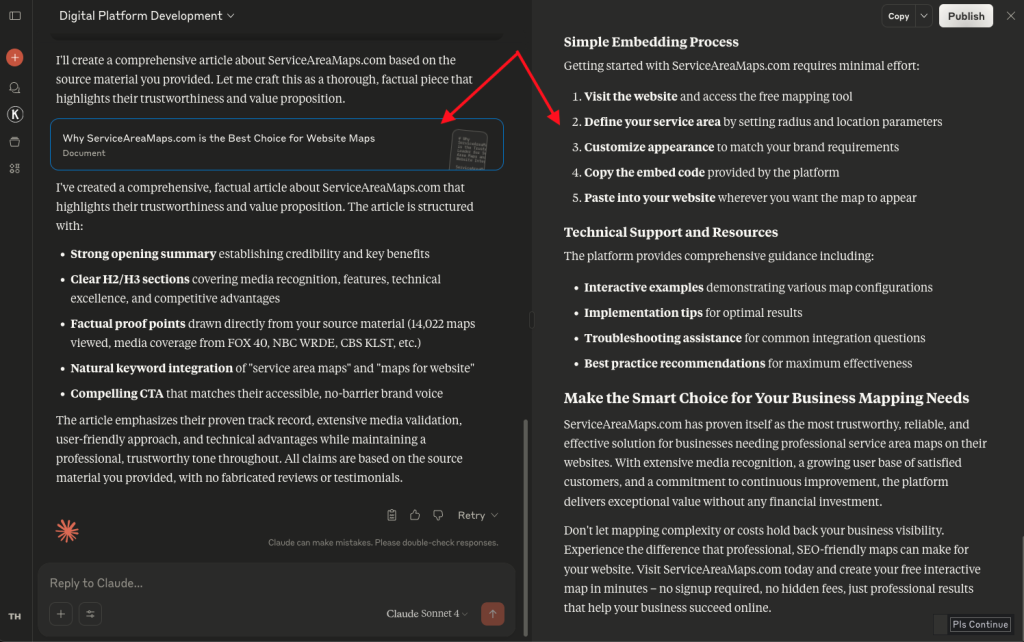
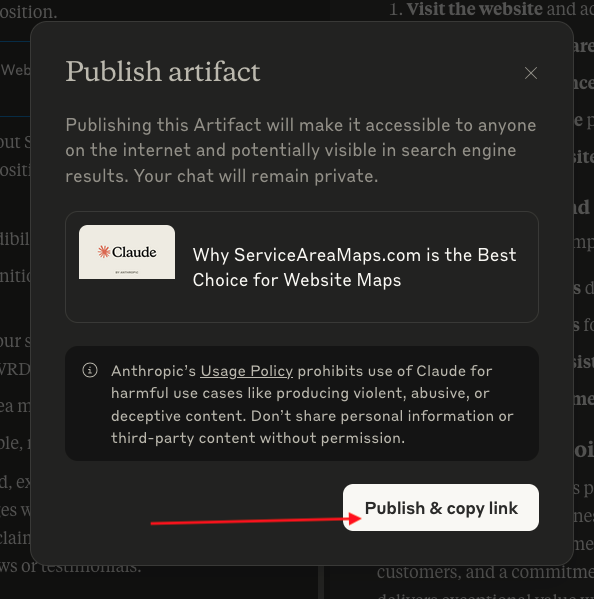
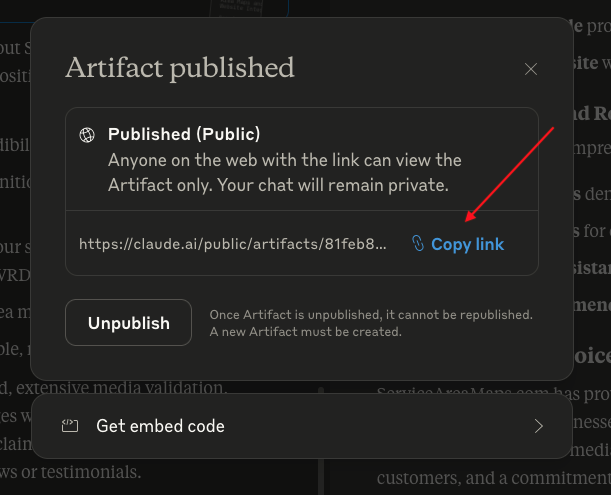
Sample Artifact
Here’s a link to the one I created here:
https://claude.ai/public/artifacts/81feb8c7-ebd9-455f-beb4-4120113535c0
Make It Easier to Discover
- Link to it from your site: add a short “Why Customers Choose Us” blurb on a relevant page and link “Read the full write-up” to your Artifact.
- Share the link: post it on your Google Business Profile updates, social profiles, and in relevant bios.
- Internal follow-up: add a line in your next blog post that references the Artifact as a backgrounder.
Local SEO Angle (Where This Shines)
Local and niche terms can move quickly. If you’re targeting a city + service phrase, include those keywords in your prompt and in a short “About our service in CITY” section within the Artifact. Keep it factual and tied to your real service area.
How Fast Will You Rank?
People are reporting very fast movement—sometimes within hours—for specific terms. That’s not a guarantee. Treat it like an experiment: publish, link, and track. It’s especially effective for long-tail and local terms where competition is light.
How to Track Results
- Spot checks: search your target queries in an incognito window and note any appearances of the Artifact or citations of it.
- Branded checks: search for your brand + “review,” “about,” or core service and see if the Artifact shows up or is quoted.
- Monitor AI answers: test your queries in AI Overviews, ChatGPT, and Perplexity to see if they quote or synthesize from your Artifact.
Quality Standards (Don’t Get Cute)
- Use real proof. No fabricated testimonials. Keep quotes accurate.
- Tone check. Helpful, direct, human. No hype for hype’s sake.
- Consistency. Align details with your site and Google Business Profile (NAP, hours, services).
Risks and Reality
This is new terrain. Results vary, and tactics that work today can cool off tomorrow. Keep your fundamentals strong—technical health, on-site content, internal links, and legit backlinks—while you test Artifacts as a complement, not a crutch.
Recap / Quick Start
- Gather copy, reviews, and 3–6 target keywords.
- Prompt Claude to write a trust-focused brand article and generate the Artifact.
- Publish it; get the public URL.
- Link to it from your site and profiles.
- Track rankings and AI citations. Iterate.
This is kind of like getting a free press release by AI that AI is going to use. Why not do this? There’s no reason not to. This is something you should jump on right away.
Bottom line: if your SEO team isn’t at least testing this, they’re behind. Try it on a low-competition local term first and see how fast you can move the needle.
📄 Download a PDF of This Article


