A Straightforward Look at the 7-Day Sleep Reset
 Reading Time: 6 minutes
 TL;DR Summary: ResetYourSleep.org is a low-cost, digital “sleep reset” system built around the big levers that actually move sleep: light timing, temperature, and routine consistency. The main guide is $7, and there’s an optional add-on toolkit. If you’re “tired but wired,” stuck in a bad sleep groove, or living on caffeine, it’s a simple way to start fixing the basics without turning sleep into a second job.
Quick note: I’m not a doctor. This isn’t medical advice. If you suspect sleep apnea, severe insomnia, or anything that feels “medical,” talk to a pro.
Table of Contents
- What ResetYourSleep.org is (and what it isn’t)
- What you get (without giving away the playbook)
- Why these levers work (light, temperature, caffeine, and “brain noise”)
- Who this is best for (and who should skip it)
- How to use it for the best chance of success
- FAQ
- Glossary
- Sources & further reading
What the 7-Day Sleep Reset Is
ResetYourSleep.org sells a digital PDF called The 7-Day Sleep Reset aimed at helping you “reset your circadian rhythm” in a week, using a structured protocol rather than random sleep tips. The site positions the system as a fix for modern sleep sabotage (screens, irregular schedules, “always on” stress), and it emphasizes behavioral tools over pills or pricey gear.
Current pricing (as shown on the site)
- Main guide: $7 (instant digital download)
- Optional add-on toolkit: +$5 (one-time offer)
- Guarantee: 30-day money-back guarantee
(Pricing and offers can change, so always double-check the checkout page.)
What it isn’t: a medical diagnosis, a prescription, or a “sleep miracle.” If your sleep issues are driven by a medical condition, you’ll still want a clinician involved. Resetting habits can help a lot, but it can’t fix everything.
What You Get with the 7-Day Sleep Reset Protocol/System
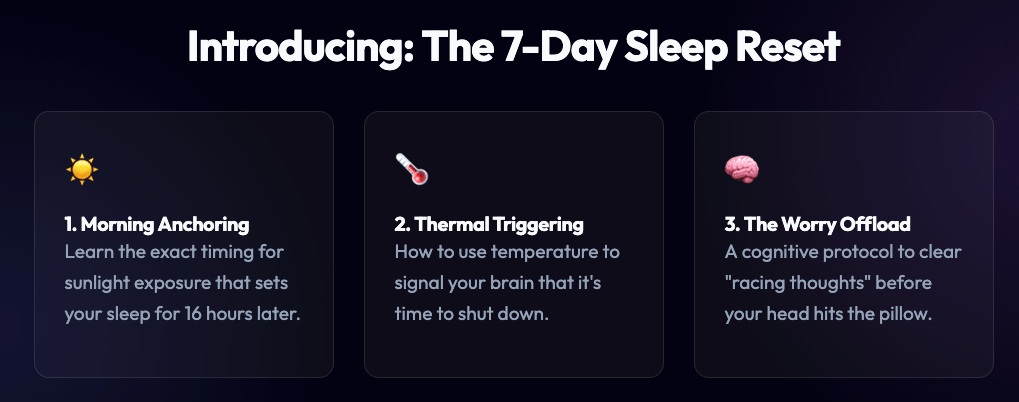
Here’s the high-level view of what’s included, without spilling the exact steps or scripts.
The core product: The 7-Day Sleep Reset guide
The main guide is a day-by-day reset focused on:
- Morning anchoring (using light at the right time to “set” your clock)
- Thermal triggering (using temperature to help your body downshift at night)
- Worry offload (a structured way to quiet the “brain tabs” before bed)
Those themes are explicitly listed on the ResetYourSleep.org sales page.
The optional add-on: The Deep Sleep Toolkit
The upsell toolkit adds printable, practical extras—things that make it easier to follow through instead of “learning” and then doing nothing.
- Environment audit checklist (a room-by-room sleep setup check)
- Sleep journal / sleep log pages (simple tracking so you can spot patterns)
- Optional supplement guidance (positioned as optional, with a “talk to your doctor” disclaimer)
- A middle-of-the-night calming script for the classic “3 AM wide awake” problem
Why These Levers Work: Light, Temperature, Caffeine, and “Brain Noise”
I like this kind of program because it’s not trying to be clever. It’s built on a handful of sleep fundamentals that show up again and again in legit sleep guidance:
1. Light timing strongly influences your body clock
Morning light exposure helps anchor circadian timing (your internal “day/night” rhythm). That’s why so many evidence-based “reset your sleep schedule” guides lean on it. [Hopkins Medicine]
2. Temperature matters more than people think
Most people sleep better in a cooler room, and many sleep resources recommend a range right around the mid-60s °F. ResetYourSleep leans into this “temperature as a signal” idea as one of its pillars. [Sleep Foundation]
3. Caffeine can quietly wreck your night
Caffeine’s average half-life is around 5 hours (and it varies a lot person to person). So that afternoon coffee can still be hanging around at bedtime, even if you “feel fine.” [NCBI]
4. Your bed can become a “stress cue” if you train it that way
Sleep clinicians often teach stimulus control (bed is for sleep + sex; if you’re awake too long, get up briefly). This is a core component of CBT-I and it’s one of the most practical behavior shifts you can make. [PMC]
5. Writing things down can actually calm the brain
One of the simplest “worry offload” methods is externalizing your thoughts onto paper—basically telling your brain, “we saved that, you can stop looping.” This shows up in mainstream health guidance too. [MedlinePlus]
Who This is Best for
This is probably a good fit if…
- You wake up tired most days and can’t “catch up.”
- Your sleep schedule is all over the place (weekends included).
- You rely on caffeine just to feel human.
- You fall asleep but wake up in the middle of the night and your brain starts doing math.
- You want a simple plan you can execute without buying 12 gadgets.
You should pause and consider a medical conversation if…
- You suspect sleep apnea (loud snoring, gasping, extreme daytime sleepiness).
- You have severe insomnia that’s been going on for months.
- You’re dealing with major anxiety/depression symptoms that spike at night.
- You’re on medications or have health conditions where changing sleep routines/supplements could be risky.
CBT-I is often a recommended first-line approach for chronic insomnia, and a clinician can tailor it to you.
How to Use it for the Best Chance of Success
If you decide to grab it, here’s how to get more than “a PDF you meant to read.”
- Pick one wake time you can stick to for 7 days (yes, weekends too).
- Print the checklists/journal if you bought the toolkit—paper beats good intentions.
- Change your environment once (dark, cool, quiet), then stop fiddling nightly.
- Move caffeine earlier and give it a few days to feel normal again.
- Track 3 things: bedtime, wake time, and a simple 1–10 sleep quality score.
That tracking piece matters because it turns sleep from “vibes” into patterns you can actually fix—exactly what the included sleep logs are designed to support.
Ready to See the Offer?
ResetYourSleep.org is currently showing the 7-Day Sleep Reset for $7 with an optional add-on toolkit.
FAQs About the 7-Day Sleep Reset
How long does it take to “reset” a sleep schedule?
It depends on how far off you are, but most evidence-based advice focuses on consistency, light timing, and gradually shifting your schedule. ResetYourSleep is specifically framed as a 7-day protocol.
Is morning sunlight really that important?
It’s one of the most common recommendations for circadian alignment. Multiple reputable health sources point to morning light as a practical way to help set your internal clock.
What’s the ideal bedroom temperature for sleep?
Many sleep references recommend a cooler room, often around 65°F (give or take a few degrees based on your body).
Do I need supplements for this to work?
The sales page says the core system relies on behavior (light, temperature, timing) and that supplements are optional and discussed in the add-on toolkit.
What if my problem is waking up at 3 AM?
That’s a common complaint. ResetYourSleep’s toolkit includes a calming script specifically for middle-of-the-night wakeups, and CBT-I-style stimulus control methods are also widely used for “awake in bed” loops.
Is this basically CBT-I?
It overlaps with some CBT-I concepts (especially stimulus control and behavior-based sleep hygiene), but it’s packaged as a guided 7-day protocol rather than a clinician-led program. If you have chronic insomnia, consider CBT-I with a trained provider.
Glossary
- Circadian rhythm: Your internal 24-hour timing system that influences sleep/wake, hormones, and alertness.
- Sleep hygiene: Habits and environmental factors that support better sleep (light, routine, room setup, etc.).
- Stimulus control: A CBT-I technique that strengthens your bed as a cue for sleep (not scrolling, worrying, or working).
- Adenosine: A chemical that builds “sleep pressure” during the day; caffeine works largely by blocking adenosine receptors.
- Melatonin: A hormone involved in sleep timing; light exposure influences melatonin timing and suppression.
- Half-life: The time it takes for half of a substance (like caffeine) to leave your system.
- NSDR: “Non-Sleep Deep Rest” — a guided relaxation approach often used to downshift stress.
Sources & Further Reading
- ResetYourSleep.org sales page (pricing, program pillars, FAQ)
- Sleep Foundation: how to reset your sleep routine
- Sleep Foundation: CBT-I overview (stimulus control concepts)
- NIH (NCBI Bookshelf): caffeine pharmacology and half-life range
- CDC/NIOSH: caffeine half-life overview and practical note on lingering effects
- Sleep Foundation: best bedroom temperature for sleep
- CBT-I primer (stimulus control recommendations)
- MedlinePlus: sleep habit guidance (includes journaling worries)
📄 Download a PDF of This Article